Question # 6
Why do you write historical fiction?
Three short answers to that:
So that people might be able to understand other people.
So that people might be able to recognize truth.
So that people, readers, might enjoy happy, rewarding lives.
Since I write historical fiction, I will primarily use that genre to support my argument(s) here but there are many other genres that I read, mystery, adventure, espionage or sci fi which can also be used to back up my opinion.
And please try to remember that.
What I write here is my opinion and I may even have some evidence to support that opinion — but that’s still all it is.
This is very early on — probably about 1955
Myself, brothers Robert and Douglas
Early on in life, sometime during my early education, I noticed that those who excel at anything enjoy it. Yes, it helps if they have a natural aptitude for it which heightens the enjoyment …
At this point I’m guessing. I have a general knowledge of several “working man” subjects, at few of which, if any, I actually “excel.”
… but even those who DO NOT excel but still enjoy it can navigate through the absorption of a basic understanding of the subject without experiencing life destroying trauma. At the same time a terrible, debilitating curse is to have a natural aptitude for a subject and find it boring, suppressive, depressive and suffocating.
I first started to see something amiss in history which led me to eventually understand this concept and apply it to other subjects.
Early on I enjoyed history but many around me didn’t, mostly because, as they claimed, they couldn’t understand why we would waste time on things we can’t change. But it was also because they couldn’t convince themselves of a need to remember dates, and thus didn’t, which was the only way the system could ensure we all read the material. If they didn’t remember the dates for the test then otherwise “smart” students failed.
But that misses the whole point of education in general or any subject in particular. Education is about being able to understand the basics of everyday life and how to avoid difficulties or find solutions to those that arise.
No, you can’t change the past, but the past is what created everyone. No, what happened 300 years ago will not have a direct effect on the student of 2026, but it may have had a strong effect on that student’s fifth great grand father, which is the reason he’s going to school in Regina and not in Prague. And perhaps alive because he’s in Canada and not the Czech Republic.
David John McGowan probably in 1890
David John McGowan, James William McGowan, Melville Alexander McGowan
March 2019. My grandfather on the left. James went to Scotland and the other two died not far from where this picture was taken in Thornbury Ont.
What happened in the past (pick a date, any date) affected who and what I am and every other living creature on the planet. In the early to mid 1800s my ancestors came to Canada from Scotland so I’m a Canadian. By the time my father was old enough for military service in 1942, agriculture had been deemed a “necessary service” and thus, his not being accepted for the Army meant I had a father, unlike many Canadians only a year or two older than me.
So, history IS important but it isn’t very entertaining. Or is it?
What makes anything entertaining? Imagination!
We attend or turn on a team sport because we imagine there will be rivalry and action. We imagine our team will win. We imagine the rival team will be humiliated. (Well, if you’re a true sportsman, that they’ll just lose.)
We enjoy a TV drama because we imagine either that “It’s the way it should be” or “might be”. Or if it’s fantasy, we imagine “wouldn’t that be great”?
It’s the imagination that offers the entertainment. A drama that is poorly written and does NOT demonstrate the emotions, desires, reactions and needs of a human being is not — without the imagination of the director, cast and special affects AND of the viewer — in any way entertaining. A team sport where 11 or 12 team-mates, covered with $2000.00 of protective gear, spend several hours crashing into a similarly equipped opposition, demonstrating no strategy (imagination) and resulting in a tie score, no matter the number, is entertaining only to a masochist.
It’s the same with history. The date of Sameul de Champlain’s establishment of the settlement at “the point of Quebec” isn’t particularly relevant, but the fact that during that summer and winter and into the next year he established close relations with the Wendat, (aka Huron), Algonquin and Montagnais peoples becomes relevant when one employes one’s imagination. For example, how large was the population increase experienced by these local peoples due to the close proximity of an all-male French settlement? The local residents taught the French to make spruce tea which helped to avoid scurvy brought on by a diet restricted to meat. How many died or how many teeth were lost before they learned of or believed this “silly peasant idea?” The building of housing and maintaining life in the wilderness is hard work and drudgery but the interaction of peoples can be very entertaining.
Realizing that Champlain and all his men, though they may have acquired titles such as sailor, explorer, surveyor, carpenter, etc. are all and more importantly people is the first step toward entertainment.
“Nobel French explorers?” Not in the least. Just a bunch of men living in a world of poverty where the only way to advance was with financial support from someone with money — in this case wealthy merchants. A similar circumstance experienced by young men of today except back then their chances of reaching 30 years were about fifty-fifty. Other than that, the same feelings, wants and desires as someone leaving high school today except less than 1% of the French population of 1600 received an organized education so their “life out in the world” could begin at about age 10.
The Wendat, Algonquin and Montagnais were the “Nobel Stoic Red Men?” Again, certainly not. But such was undoubtedly possible to a greater degree than with the French for they had learned that helping each other in the world of basic survival against the elements kept members of the tribe alive so that they might help you when you reach a place where you could not survive without that help. Thus the very people and the memory only persist if each work toward the survival of all.
And right there is where you find another important part of reading – and writing for that matter — fiction. You discover the fulfilment, the pleasure, the personal development and need for empathy.
A person who does not understand that their contribution, even though it may be minuscule, is not only necessary but required for the creation of a community or a country, has never read fiction. A person that has no understanding of the forces that motivate another, has never read fiction. A person that can neither benefit from or be comforted by another person’s emotions, has never read fiction. A person that falls prey to fantasies or outlandish stories that lead to financial loss or identity theft has never read fiction. A person who believes the stories that lead to successful frauds has not read fiction and cannot be expected to understand the difference between the “logic” and “characters” to be found in good, entertaining fiction about people and the lies spread by those trying to make you comfortable and take your possessions —- perhaps even your life.
That’s why reading fiction is so important to the creation of a “whole ” person.
You might think your neighbor is “one weird duck” but after reading about different personalities you realize that it’s possible that the “weird duck” might have perfectly legitimate reasons for what you think is an “unconventional” view.
Why do I write historical fiction? So that people, including the writer, can have rewarding, enjoyable, productive lives. That they can form communities that grow with people of like minds. That they realize that those with other ideas are not necessarily evil and deserve the opportunity to express those thoughts until they interfere with the ideas of the majority.
Why do I write historical fiction? So that those who have read it can recognize a bad idea when it appears as having resulted in distress in the past. So that those who have read it can recognize evil, sociopaths and psychopaths quickly — who have all put in appearances before — and get as far away from them as possible.
Leave a comment or take a look at a few slide-shows with some dialogue on my YouTube channel https://www.youtube.com/@davemcgowan6231
A book should be good for at lest three reads over the years.
Or if you don’t have much of a memory, indefinitely.
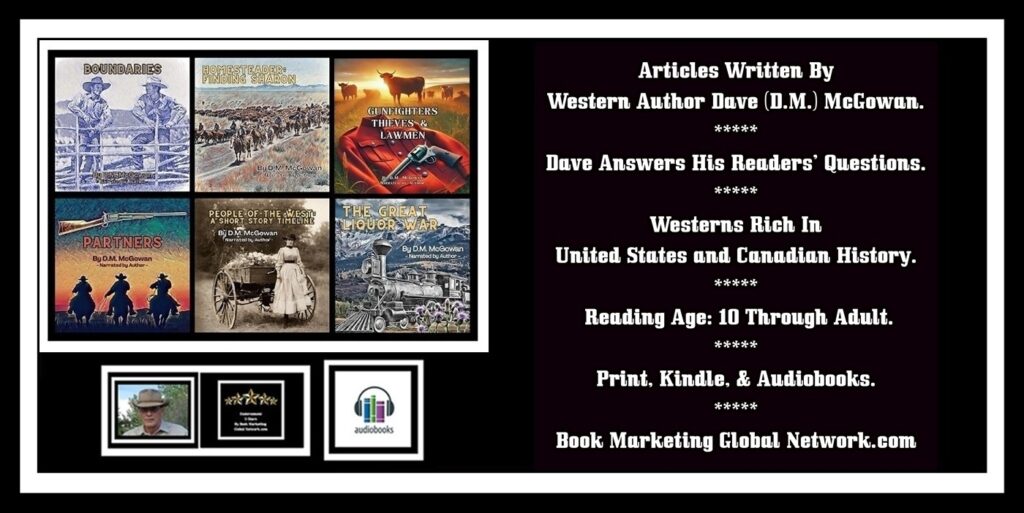
The book banner below is from Book Marketing Global Network where there are links to most of my books on my page at https://bookmarketingglobalnetwork.com/category/author-and-partner-dave-d-m-mcgowan/

View Our Site Map (Directory):
https://bookmarketingglobalnetwork.com/book-marketing-global-network/site-map-index/
Article Submitted To Book Marketing Global Network: 09/23/2026
